
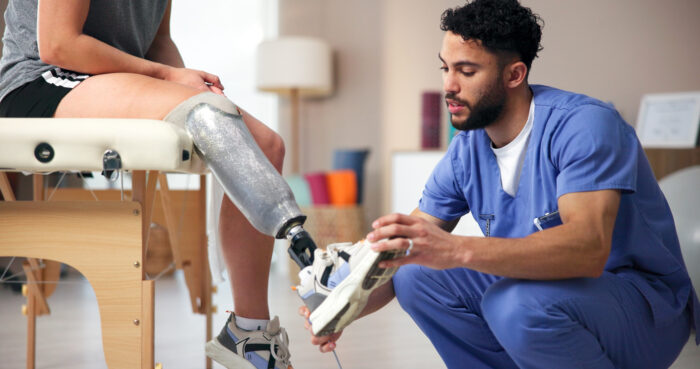

Navigating the aftermath of limb loss takes commitment, dedication and hard work. Whether an amputation is the result of an accident or negligence, we aim to help you get the ongoing rehabilitation and support you need to maximise your independence.
We understand how the interplay between prosthetics, rehabilitation and the lifetime costs of care is essential for securing a settlement that truly reflects your future needs. Our core value is that rehabilitation comes first. We work collaboratively with insurers to assess your needs immediately so we can help to maximise your outcomes.
Your case manager’s role
In amputation claims, there is a large team around the injured person. We instruct a Case Manager to conduct an Immediate Needs Assessment (INA). They are a rehabilitation professional and will be chosen carefully as being someone with the necessary experience to support the injured person and who you will be able to build a strong relationship.
Their role involves:
- Coordinating your rehabilitation: Managing your rehabilitation team, including physiotherapists, occupational therapists, and prosthetists.
- Navigating healthcare: where appropriate, helping you bridge the gap between NHS services and private specialist care.
- Managing transitions: Assisting with the discharge from hospital to home and ensuring the right support is in place for you and your family.
Rehabilitation pathways
The scope of rehabilitation is wide.
Physical and occupational therapy
- Specialist physiotherapy: This includes core strengthening and prevention of secondary issues like joint strain or skin breakdown.
- Occupational therapy (OT): Focuses on “Activities of Daily Living” (ADL). This may include fatigue management, home layout assessments, and training in using adaptive technology to regain independence.
Psychological and social support
The mental impact of limb loss including grief, PTSD, and “Phantom Limb Pain”, is significant. We ensure funding for:
- A wide range of psychological therapies following specialist assessment
- Family support: Recognising that a serious and catastrophic injury affects the entire household.
Vocational rehabilitation
Returning to work is a vital milestone for many people after an amputation. If you cannot return to your previous role, your claim may cover:
- Workplace adaptations: Specialised equipment or ergonomic office setups.
- Retraining: Funding for new qualifications or degree programs to facilitate a career change.
Prosthetics in amputation claims
If a prosthetic is recommended as part of your rehabilitation, we will ensure you are properly assessed at a specialist clinic.
Advantages of prosthetic limbs
- Independence: Replacing a lost limb with a prosthetic can allow for mobility changes in both the upper and lower body, enabling better functionality and a sense of independence without needing to rely on other equipment.
- Psychological: Replacing a lost limb will help to regain confidence in self-image and can help towards re-joining social activities and being around others after serious injury.
- Technological customisation: Prosthetic technology has advanced throughout the years, and options such as osseointegrated prosthetics may fit better and feel closer to a new limb. An individual’s preferences in terms of material and fabric/colour can also be implemented with many prosthetic limbs.
We can also secure funding for activity-specific prosthetic limbs.
Helping you rehabilitate at home
Rehabilitation can be difficult if your home environment is a barrier. From a legal perspective, we view the home as fundamental to your rehabilitation. Where necessary, we ensure that your home environment is adapted to make life as comfortable as possible.
Interim payments and calculating lifetime costs
Many people worry that they have to wait until the end of their claim (which can take years) to receive money. We alleviate this financial burden by securing early interim payments – which are essentially early releases of your compensation that can help ease financial worry.
Get in touch with our amputation solicitors today
We have shared this article for informational purposes only and does not constitute legal advice. If you or a loved one have been affected by amputation, we encourage you to contact our friendly team of serious injury experts who are happy to help. You can call us free on 0808 164 0808 or request a call back, and we will call you.